

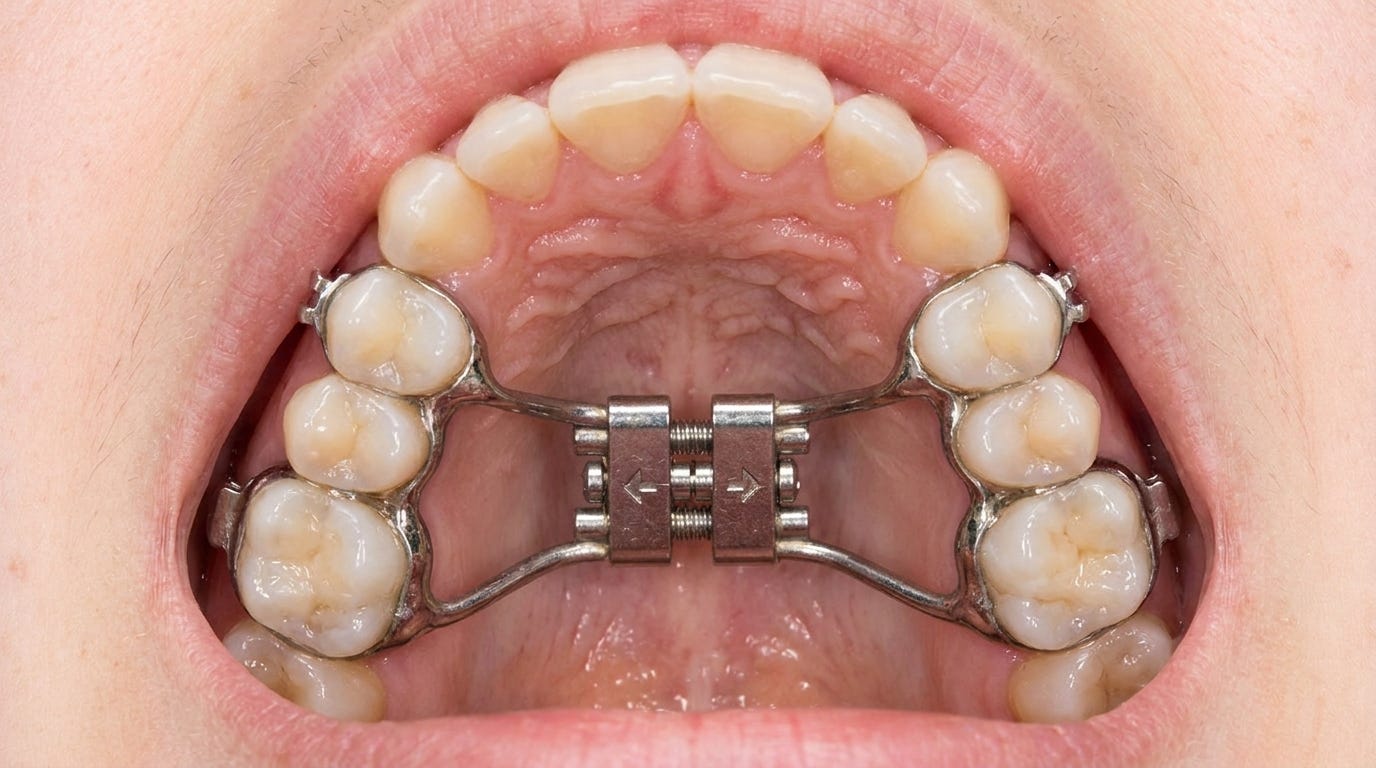
All over the place I hear about people saying the want to start the MARPE appliance.
As if it’s some great savior that is going to make them beautiful with big, wide arches.
The idea that we can split the roof of a mature skull using screws and force isn't just intense. It’s misguided. But somehow, it keeps popping up.
In airway circles. In craniofacial threads. In reels from influencers who’ve tried everything else for jaw pain or breathing issues and now think this might be the solution.
Spoiler: It’s not.
So what is MARPE anyway?
MARPE stands for Miniscrew Assisted Rapid Palatal Expansion. It’s a metal device that gets anchored into the roof of your mouth with titanium screws. The goal is to force the upper jaw wider by splitting the midpalatal suture, the seam down the center of the hard palate.
The video above is a great way of seeing exactly how they ‘think’ it works.
The claim is that doing this will expand the nasal airway, create space for the tongue, improve sleep, and reduce jaw tension.
But here’s the problem. This method works against the body’s natural mechanics. It’s like using a car jack on a balloon.
The screws are there to add brute force. But the force doesn’t just expand in one area. It distorts the entire cranial system.
And when you introduce that kind of instability into the skull and spine, the consequences are typically always negative and add up over time.

MARPE doesn’t just fall short. It causes harm.
I’ve heard from people who were sold on the promise of MARPE. People who struggled with chronic mouth breathing, TMD, and poor sleep. People who were told this appliance would finally solve it.
Years later, they’re dealing with new problems. Worsening facial asymmetry. Tension headaches. Spinal misalignment. Neurological symptoms.
Within our community, there’s a number of people that did MARPE and feel they were damaged from it.
Even when patients report that their palate expanded, it begs the question. Did their health improve or just their scan? From everything I’ve seen, the structural compromise far outweighs the perceived gain.
Here are some of the things pointed out in the study i referred to above.
1 - teeth tipping

2- tooth necrosis

3- periodontal issues

4- root resorption

5- assymetric expansion

I mean… how many different signs do you need that something is not good for you?
When someone uses a flat mouthguard (eg. Myobrace, Reviv, etc)…. the only slight side effect in my view & experience is that there is temporary irritation of the gums. Which typically resolves over time and gums typically end up even healthier than when you started. As it has for me.
This other shit listed above… NEVER HAPPENS.
And yet you will find in time… people getting just as much expansion using a simple flat mouthguard as these people doing this MARPE.
The process might be a bit slower but it is FAR, FAR HEALTHIER.
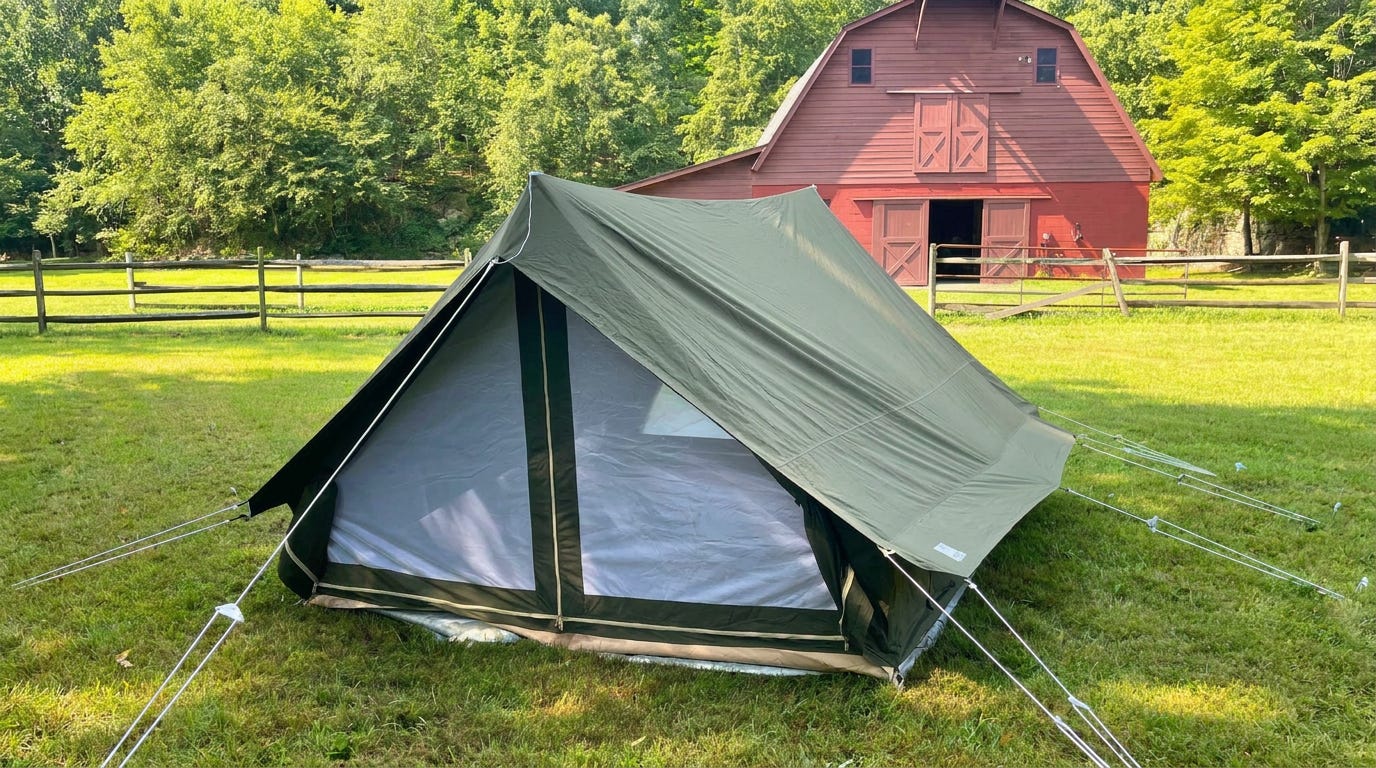
Here’s what’s happening when you do MARPE
Imagine your skull is a tent. MARPE is like jamming a metal rod through the roof to make more space. You might get a bit more room, but at what cost to the fabric, the tension, the support lines holding everything together?
Instead of working with the body’s adaptive systems, MARPE overrides them. The body compensates. But those compensations come with consequences.
Because the body isn’t static. You don’t just move one piece and expect the rest to stay still. You shift one part of the skull, and the spine, neck, and nervous system all respond.
Pretty much always in damaging ways.

Closing thoughts
I don’t believe MARPE is a misunderstood tool. I believe it’s a fundamentally flawed one.
It treats the skull like a static object. It ignores soft tissue dynamics. It relies on force over function. And in doing so, it creates instability in the very system it claims to support.
MARPE isn’t neutral. It isn’t harmless. And it’s not a “maybe it’ll work for you” kind of tool.
It will expand your arch in a way that creates more assymetry in the skull and leave you with an occlusion that will result in even more collapse in the coming years. For the reasons i explained here:

The structure of your skull isn’t something to gamble with. And any method that relies on mechanical force to override natural biomechanics is a method worth questioning.
Because if the outcome is pain, dysfunction, and long term collapse, then all you’ve achieved after spending all that time & money is the creation of more problems.
Following your blog, it actually shocks me how stupid and primitive the dental industry is.
I mean, come on, dentistry has been around for thousands of years. Modern day dentists are supposed to be relatively smart, high IQ people. How difficult is it to figure out that changes in the dental structure will also impact the rest of the skull, if not the neck and spine? You would think, after studying the anatomy, after years of seeing how clients respond to their treatments, after looking at thousands of jaws, teeth and the accompanying bone and facial structure, that they would make the connection. The jaw at least doesn't directly attach to the neck and spine, so I can give some leeway if they don't see a connection there. But the skull? Doesn't the entire skull rest on top of the jaw? If you just look at the photo of a skull, its blatant that adjustments to the jaw structure will likely translate to shifts in the skull structure.
The cosmetic industry, I get that its a high-risk high-reward industry. I assume that there is an unspoken expectation that there are risks in the cosmetic surgery and cosmeticians are relatively upfront about it. But people go to dentists thinking that the dentists know best, but the dentists don't even seem to consider what is blatant and obvious and in-your-face. Its actually another metaphor for how disconnected modern society is - they don't even grasp the connection between the jaw and the skull and think that you can fiddle with one without affecting the other, as if you could shift the foundations of a building without impacting the stability of the structure.
***
I was thinking more about how the mouthguard works in relation to 'opening' the body. And I realised, vertical movement of the jaw is very natural. In fact, during times of relaxation, our jaw moves vertically. When we sigh with relief, the jaw drops down gently. When we yawn, our jaw stretches maximally, opening the mouth and body as much as possible. When we cry, when we laugh, when we verbally express ourselves, the jaw moves vertically. So the jaw is *made* to move and open vertically. Not horizontally.
Horizontal stretch? WTF? The jaw is not made to move or stretch horizontally. At most, our mouth and lips stretch horizontally when we smile, but that is mostly a movement of the muscles, not the jaw and bone.
There is some really barbaric and stupid people out there. Hey, this person has a narrow mouth, why don't we just force it wide open. Hey the bridge arch is too narrow, why don't we expand it so that bigger ships can pass below it? Maybe we can compress a person's skull and they will think just fine.
I can't personally attest to Reviv as I have no experience with mouthguards and have mostly avoided going to the dentist (always had a natural aversion to them which seems like a healthy instinct). But I can see that the jaw moves up and down vertically, so a mouthguard that "adds vertical height" doesn't seem that problematic as we are 'playing' along the natural lines and structure of the body.
But after thinking through and seeing the video of how the invisaligner changed the occlusion of the teeth, I can easily imagine how the skull structure could be all messed up once you mess with the teeth and the jaw. The front of the skull rests on top of the upper and lower jaw. If you move the bone structure around, which is what happens when one attempts to realign the teeth or jaw structure, everything that rests above will also shift accordingly. It seems like many attempted teeth alignments result in the 'sides' of the jaw flattening downwards. Thus, the sides of the skull which rest on the jaw will similarly be translated downwards. The general effect of this is that the "upper" front-skull collapses downwards which generally has a 'narrowing' effect on the face and compresses the skull downwards. The back of the skull is similarly 'pulled' along, resulting in the poor side-profile that often results.
Of course, how the body structure changes depends entirely on the nature of the dental work done, the body's natural structure, the person's body-intelligence-awareness.
Now if one has very strong body awareness, it may be that their body naturally recognises this dysfunctional alignment and may spontaneously correct it. After all, this dyssmetry is surely uncomfortable for the body, and if the person has enough body-awareness and intelligence to allow their body to self-correct, the misalignment can be avoided or corrected. But most people are probably incapable of this, and thus, are simply pulled along 'downwards'.
***
Now what happens if, instead of 'pulling down' the skull, we 'push it up'? Then the entire portion of the skull that rests on the jaw is 'raised up'. It seems possible that the brain might have more 'room' to breath and space 'on top'. Of course, its not necessarily 'the higher the better', but if one's alignment is 'too low' to begin with, then a vertical correction would definitely be helpful.
That's why I think the 'complete' solution in fact lies with body-awareness. When one gains very strong body-awareness, they will be able to allow their body to self-correct to its optimal alignment.
So how can we move this 'alignment' upwards in a way that makes natural, intuitive sense and logic?
Besides the reviv mouthguard principles you outlined, I got to thinking what else could be possibly helpful.
And the one exercise I thought of that struck me was 'yawning'. Yawning seems like quite a spontaneous body-expression to relieve itself. After yawning, there is generally a sense of relief and relaxation and the world seems to open up and come 'alive' a little bit more. And notice how wide the entire mouth and jaw opens itself, stretching and expanding itself maximally outwards. So I tried yawning a few times, and as I did that, I noticed how the yawning "stretched" all the different tight spots along not just the face and jaw, but even the neck and shoulder lines, the ears, the throat, the suboccipitals all stretched out.
Still, with my own body-awareness, there is one particular 'type' of stretch that my own body wants to focus on which is the right-suboccipital. Everyone will have their own particular stretches that their body wants to focus on as their main place of tension. General exercises will help some more than others, since the general exercises will target areas of tension that are specific to some but not others. In this way, I think Reviv will be particularly helpful to victims of dentistry, as it focuses on fixing the part of the body-mechanic that has most likely been most 'messed up' by orthodontics.
Oops that send accidentally.
I will continue here:
Omg it makes so much sense now.
When I was younger, before getting my braces, I had a MARPA. Unfortunately, it had to be removed because instead of expanding outward to create more space, it started pushing inward. The pressure was so strong that it caused a wound on my upper palate — the metal was actually growing into the tissue, and it was incredibly painful.