

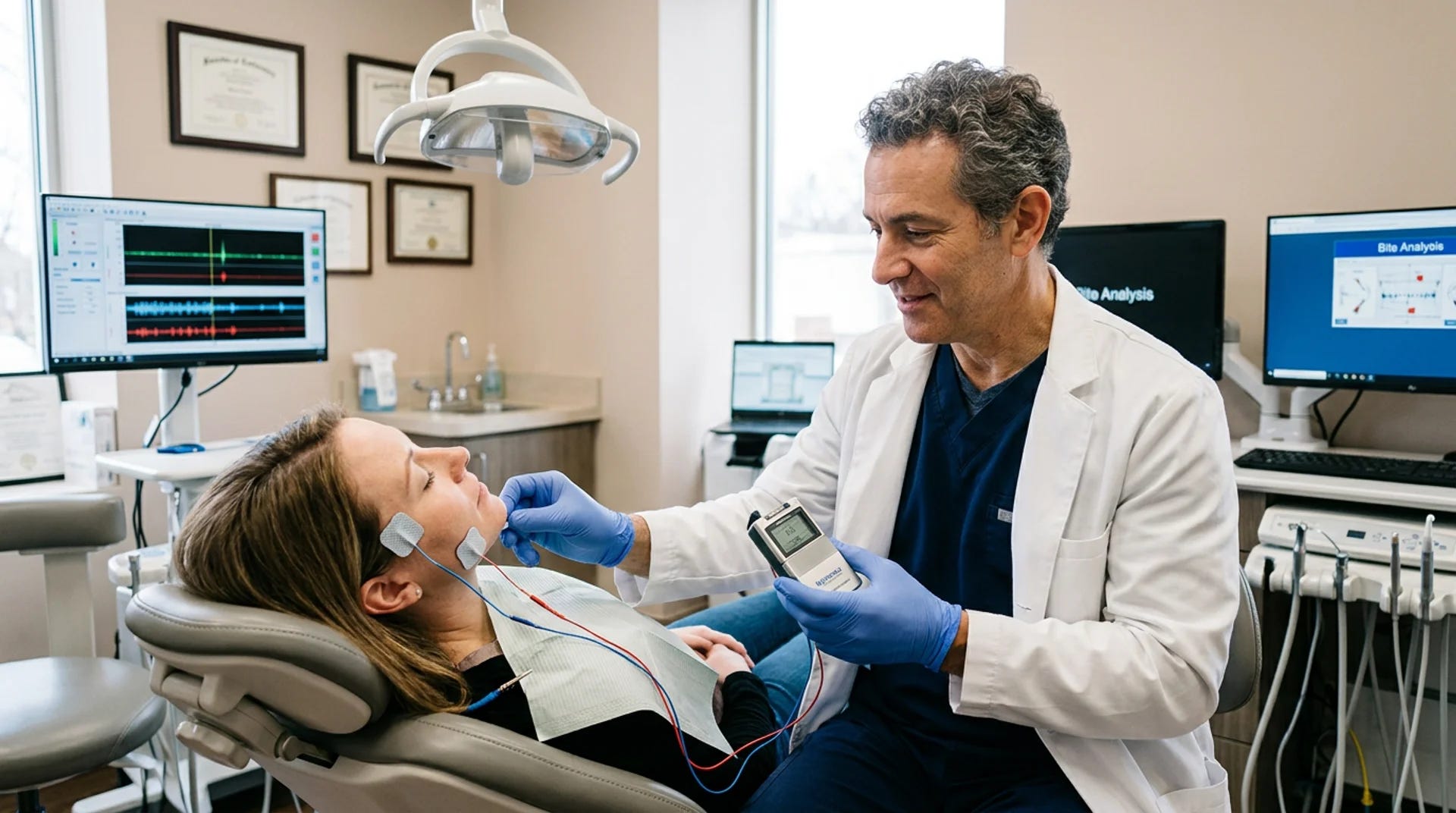
I get asked about neuromuscular dentistry (NM) a fair bit.
People find it because it sounds sophisticated — TENS units, EMG readings, the promise of finding your jaw’s “true” resting position using actual measurable data instead of just eyeballing a bite.
But it’s not some scientific version of what I do. It’s not even close.
Because they don’t understand the skeleton. Your bite is always changing — it takes years to unwind the skeleton, and the bite keeps evolving that entire time.
Thinking you can measure one relaxed position and “fix” the bite there permanently is, frankly, absolutely stupid. And I say that having tried it on myself many times in my early years.
What neuromuscular dentistry actually is
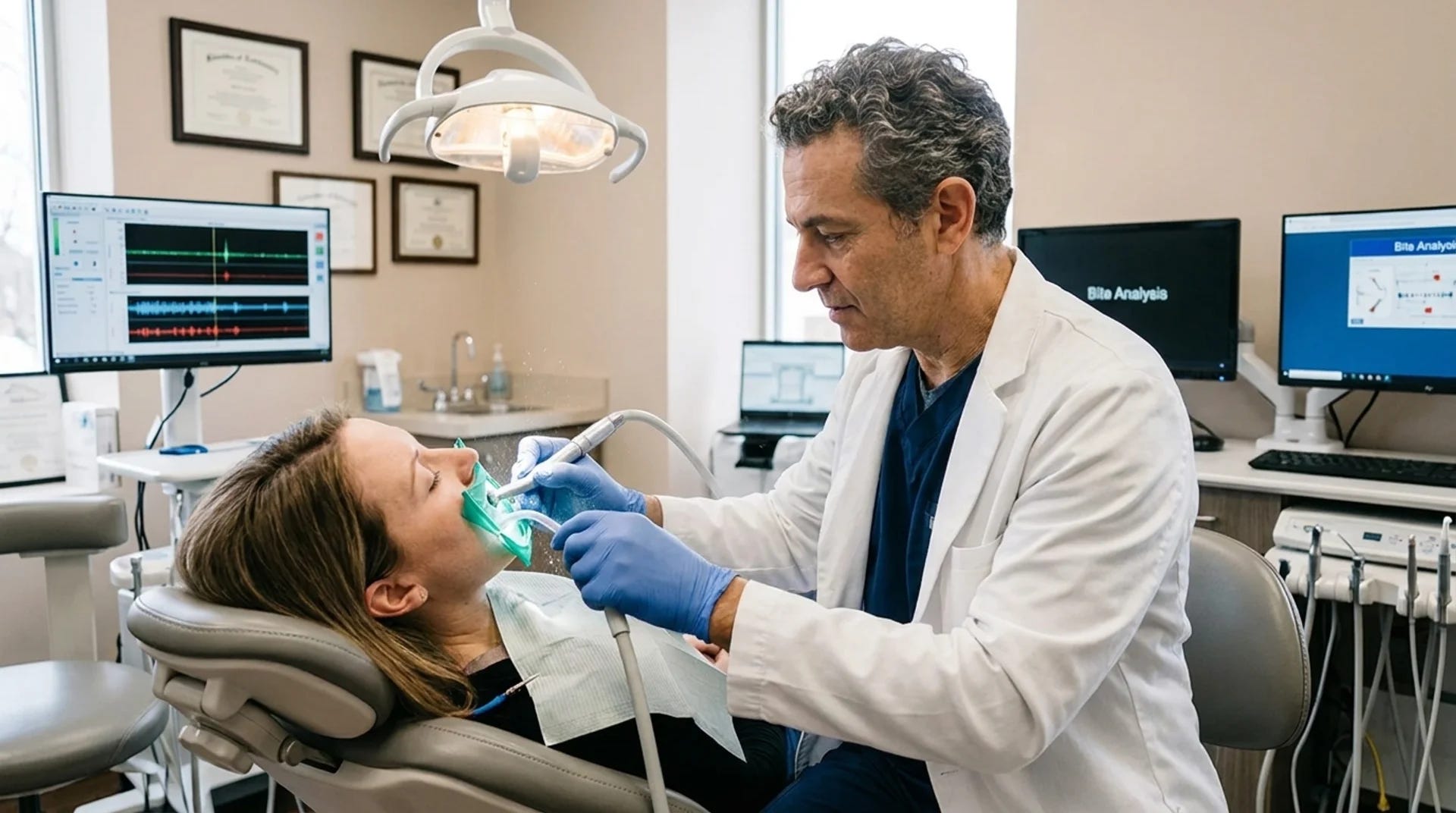
The core idea behind neuromuscular dentistry is that most people’s bites are misaligned relative to where their jaw muscles “want” to rest, and that this mismatch is the source of TMJ pain, headaches, and a long list of other symptoms.
To find the “correct” position, practitioners use a TENS unit — a small device that sends electrical pulses to relax and fatigue the jaw muscles — combined with EMG readings that measure muscle activity, and sometimes jaw tracking devices that record how the mandible moves.
Once they’ve used the TENS unit to get the muscles into what they consider a relaxed, neutral state, they measure where the jaw naturally wants to sit in that relaxed condition.
That becomes the target “neuromuscular bite.”
From there, treatment usually involves an orthotic device to hold the jaw in that new position, and eventually — this is the part that concerns me — permanent changes to the teeth themselves, through equilibration (selective grinding), crowns, or full-mouth reconstruction, to lock the bite into that new position long-term.
How big is it?
This isn’t a fringe idea.
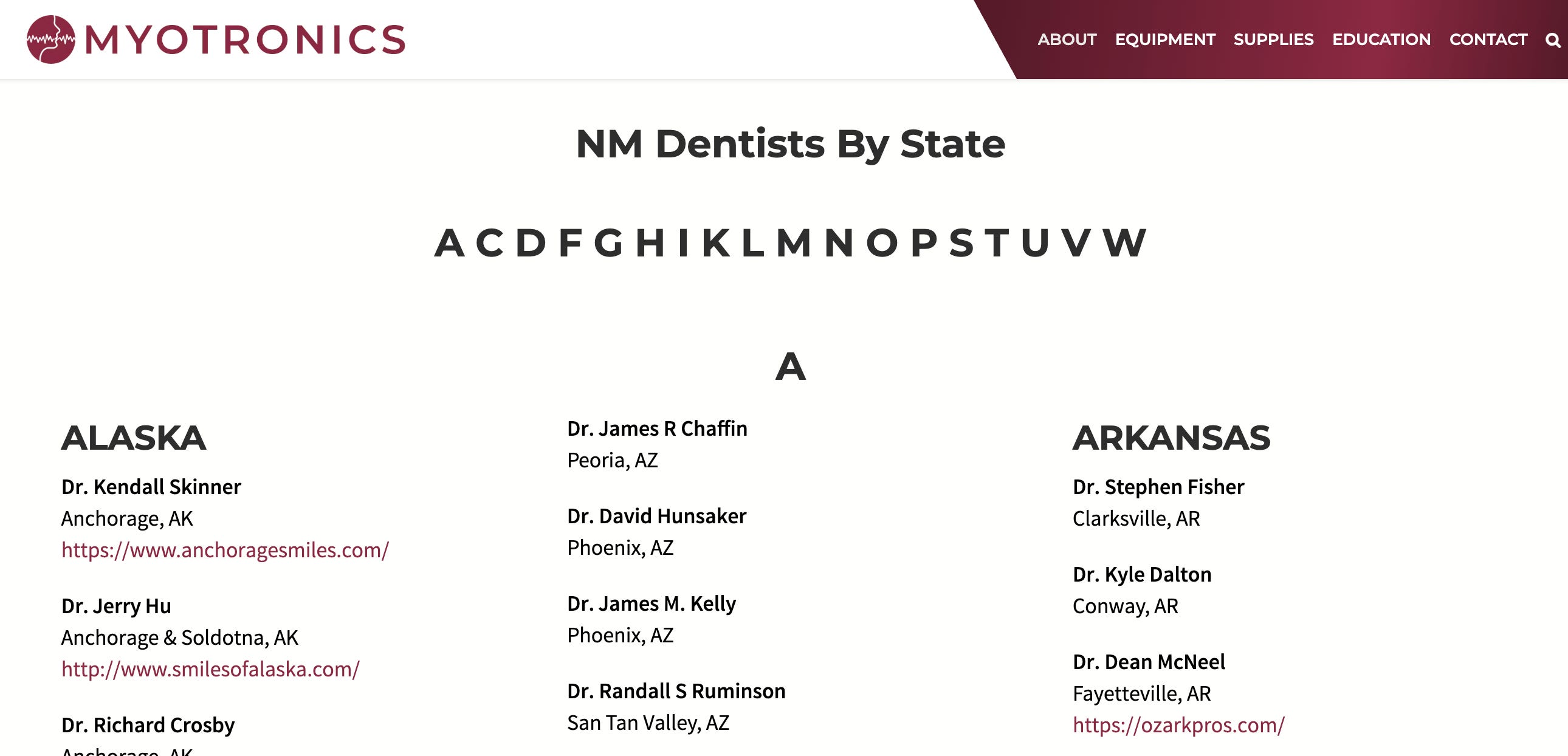
Neuromuscular dentistry has its own professional organizations, its own certification pathways, and a whole ecosystem of continuing education courses built around specific technology brands — TENS/EMG systems (eg. the K7x by Myotronics) are the backbone of the entire approach and are marketed heavily to dentists as a way to differentiate their practice and justify premium fees for full-mouth work.
There are well-known practitioners who’ve built entire careers and patient followings around this framework, often branding themselves as TMJ specialists or “neuromuscular dentists” and drawing patients from across the country who’ve struck out with conventional dentistry.
I had a quick look at the Myotronics NM dentist locator (screenshot above) and they have a list of several hundred dentists in the US and abroad.
So it’s a legitimate, established, and pretty well marketed corner of dentistry - which is part of why I think it’s dangerous.
I actually tried this myself back in 2014-2015
Before I go further into why I disagree with the philosophy, let me start by saying that I used to test it’s fundamentals on myself in my early years.
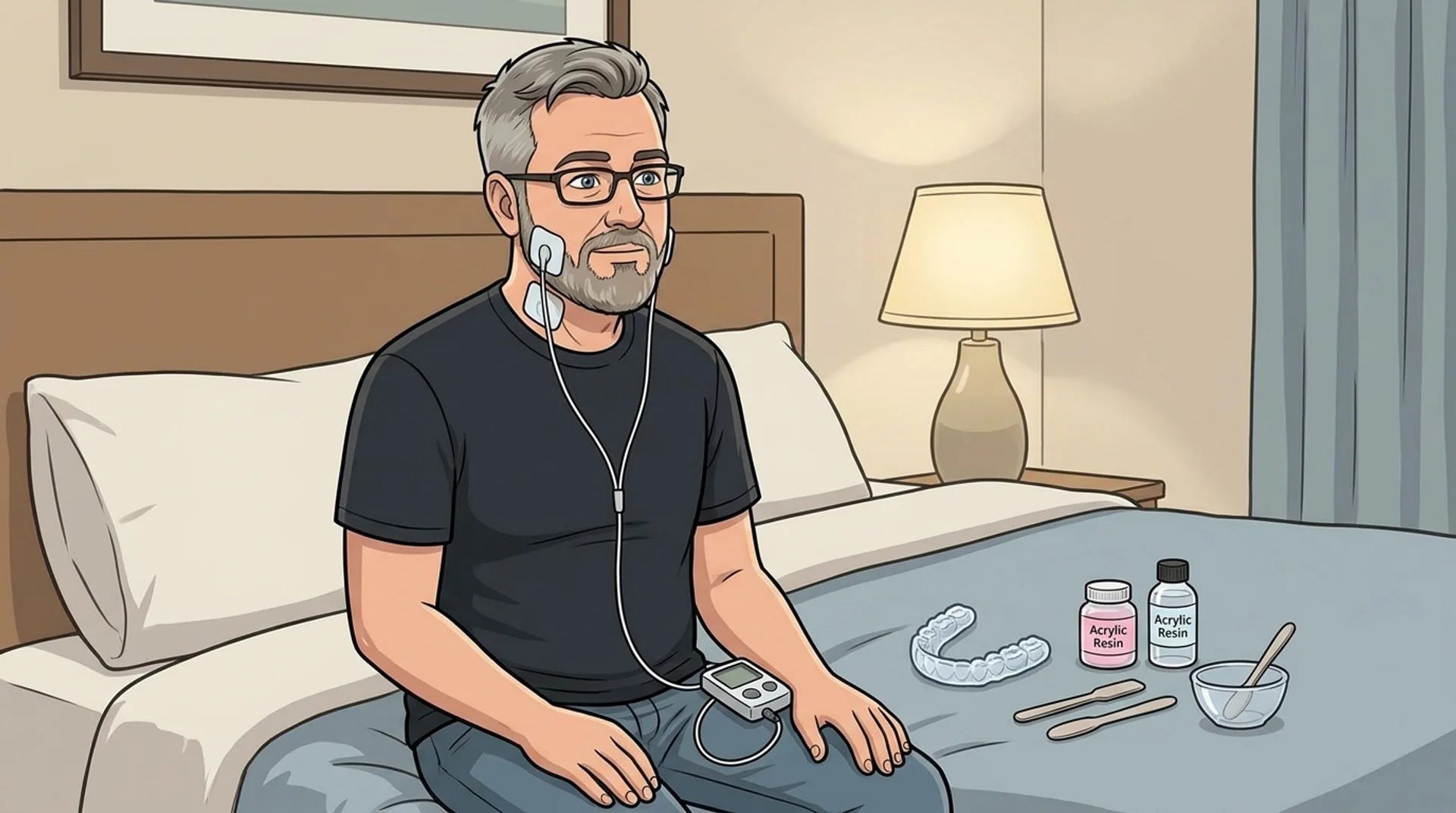
Back in late 2014 and 2015 I was doing Starecta, which is a popular DIY method where you lock a single jaw position with an indexed splint. These days they use polymorph but back then I was using acrylic resin and making + adjusting my own splints.
I also had my own TENS unit that I would sometimes use to relax my jaw muscles. And I was familiar with neuromuscular dentistry because some of their dentists would be frequently posting on the major TMJ Facebook groups of the time.
So naturally, I did what the neuromuscular model tells you to do. I tried to lock that new position in. I would index a splint to capture the bite I got right after using the TENS unit, treating it as the “correct” position I’d finally uncovered.
But I would notice that things would change within a week or two. And my jaw would not fit neatly into the indexed splint i had made. Rather it would hit some kind of interference and then slide into the position set by the splint.
And so i further experimented. I would relax my jaw, index a splint to that position and then further use the TENS unit for another hour or so.
Even after an hour I noticed that my jaw already did not go evenly into the indexed splint i’d made an hour earlier. Rather it would hit an interference and then slide in.
Then I tried re-indexing the splint at periodic intervals, like every couple weeks, thereby mimicking the logic behind the regular adjustments that NM dentists make.
But the problem was I didn’t feel like i was progressing… rather I felt like i was going in circles.
It would take another year or two for me (approx 2017) to figure out why. And the reason was that they didn’t understand that on a locking bite the jaw needs to be supported in multiple positions as I wrote here:

Since they were locking only a single position… you were essentially doomed to go in circles and decline over the longer term.
Which is what i’m pretty sure is happening to all NM patients if they reflected on their situation honestly.
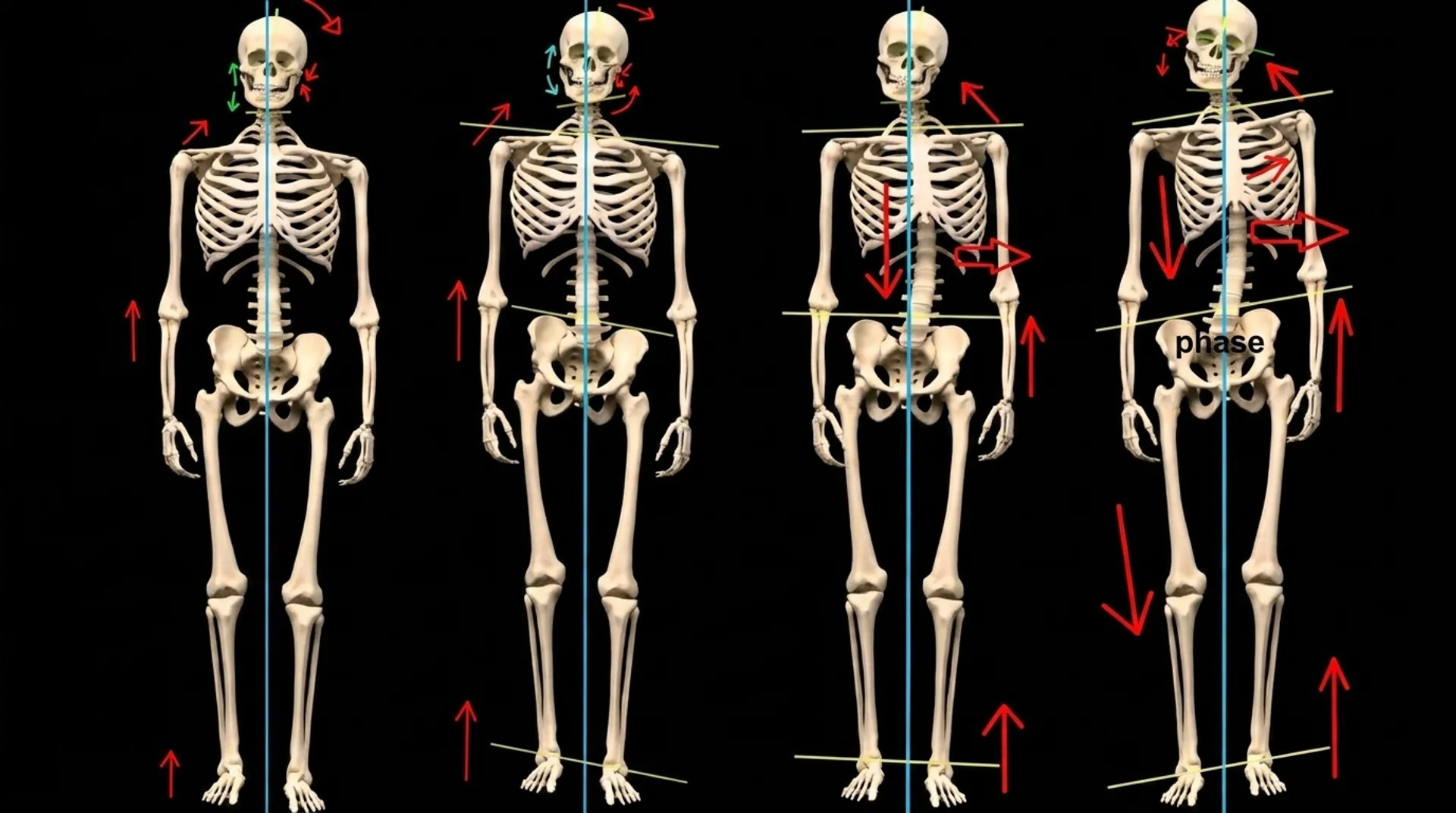
Why they don’t understand the skeleton
Here’s the fundamental issue.
Neuromuscular dentistry treats the bite like a fixed puzzle with one correct solution — find it once with the right equipment, lock it in, done. That’s only possible if the bite is a static thing sitting on top of a static skeleton.
But the skeleton isn’t static. It’s always in motion — either collapsing or resurrecting (if you know the correct biomechanical rules).
And because the bite is downstream of the skeleton, the bite is always changing too.
Unwinding a collapsed skeleton back toward correct structure isn’t a one-day event. It takes years. And the bite keeps evolving the entire time that unwinding is happening, because it’s simply reflecting whatever position the skull, jaw, and spine happen to be in at that moment.
So when a neuromuscular dentist relaxes your muscles with a TENS unit and captures a bite, all they’ve captured is a snapshot of your skeleton on that particular day.
They haven’t found “the” bite. They’ve found “a” bite — one frame out of a multi-year film. Treating that single frame as the final answer and building permanent dental work around it isn’t scientific. It’s a fundamental misunderstanding of what the bite even is in my view.
That’s exactly why I went in circles with Starecta during those early years. Something i wrote about here:

I wasn’t failing to find the right position. I was correctly capturing a different, real position every time — because my skeleton was constantly changing.
Even worse… my skeleton was probably collapsing most of the time since I was locking only a single bite and so I was adjusting my splint to my evolving bite as my skeleton was in freefall.

The million dolla question
Here’s a simple test I like to put to anyone who’s a believer in neuromuscular dentistry: find me someone who did full neuromuscular treatment five-plus years ago and is genuinely still happy with it.
No lingering issues, no return of symptoms, etc.
I was on TMJ-related Facebook groups a ton between 2014-2018 and I don’t remember ever having found one.
I ran into lots of people that had done NM, but the story always seemed to be the same. It sometimes felt good, sometimes felt like they were getting worse, but it did not feel stable.
And the reason for that most likely was that their skeletons were constantly evolving (probably for the worse).
Why the tooth-grinding part is genuinely dangerous (in my view)
This is the part that I disagree with completely.
Once a neuromuscular dentist has identified their target bite position, the standard path to “finishing” treatment often involves permanently altering the teeth to match it — grinding down enamel through equilibration, or placing crowns and doing full-mouth reconstruction to lock the new position in place.
So they are permanently altering your teeth for this bite that they think they have found.
But the ‘bite’ was just a snapshot, and an incorrect one at that.
So they charge your lots of money for essentially permanently reshaping your teeth based on their ‘philosophy’.

Closing thoughts
The heart of the matter is that neuromuscular dentistry looks at the problem completely wrong in my view.
To resurrect someone’s skeleton you need to add vertical and unlock the current occlusion…. and then their bite needs to be allowed to constantly evolve for years as they recover.
Locking a single bite is the opposite of what you want to do.
And it is not about relaxing muscles in my view… rather this whole biomechanical game is about stretching. You need to inflate the skull and skeleton little-by-little over time. Over years.
So who is right and who is wrong?
Well get onto our Skool community and read through thousands of user posts and then get onto some of the Facebook TMJ groups related to Neuromuscular Dentistry and read those posts.
Then you decide.
I’m pretty confident I know what you’ll conclude ;)
I agree, neuromuscular dentistry is completely wrong, and all this "electric" business makes no sense at all. But desperate people get mesmerized by the "shiny, cutting-edge" equipment that these neuromuscular doctors promote and think that since everything is so perfectly measured, it's backed up by actual science, when mostly it's not.
Heck, a hack doctor (no rhyme intended :D) where I live even mentioned in her brochure that one of the reasons she has that kind of "diagnostic equipment" is to inspire greater trust in patients during the "therapeutic process." So, put another way, she's saying, 'I own these shiny things so I can entice you to pay me to treat you.'
there is something very 'myopic' about the modern 'western' way of thinking which is that they tend to focus on one specific part without seeing and taking into account the all the other 'parts' and the greater 'field'. the jaw is connected to the whole body, the muscles, tissue, and its 'natural' position changes all the time depending on the activity and environment! just like there is no 'fixed' position your arm wants to be in...if you're standing, sitting, lying down, throwing a ball, doing a push-up, the natural position of the arm changes all the time!
as you said, its like they take one frame of a whole spatial-temporal reality and assume that that is all they need to study and work on.
the muscles and posture of the jaw is connected to the entire body. if your skeleton is misaligned (almost everyone's is, and the older you get, the worse it becomes), it affects every part of the body. similarly, to get the 'true position' of the jaw, you'd need to fix all the tensions and misalignments in every (well not every, but at least the 'core' parts) part of the body, and even then, it literally changes depending on whether you're standing, sitting, or lying down, because of how weight and gravity redistributes.