

Youtube version
A family member went to doctor recently because they felt a bit ill.
This same family member has been using a flat mouthguard on and off for a couple years but never really takes it seriously.
I have asked them many times if they were wearing it every night and I could never get a straight answer. But I can see clearly they haven’t unlocked their bite so it’s clear they are not wearing it nearly as much a they should.
When I mentioned that I don’t think they’d be getting ill like this if they wore the mouthguard more regularly they interpreted it as if i’m joking.
To them doctors are the experts. And i’m the guy talking shit because I don’t have the MD diploma on the wall.
But the thing is…. this person was never a good first principles thinker. They always put ‘experts’ on a pedestal and accepted what they said as true their entire life. So it doesn’t really surprise me that this is their attitude.
I was the opposite. I always thought to myself what I considered to be logical and true based on the evidence and logic at hand. Regardless of what the ‘expert’ in front of me said.
People typically need to earn their credibility with me because i give very little at face value. And I generally found that that attitude served me best in life..
And today I want to talk about this because I’m sure many of you will have similar frustrations trying to get loved ones (eg. parents, grandparents, etc) to start this process.
Because they just won’t take it seriously and the root cause of that is typically that they are poor first principle thinkers.
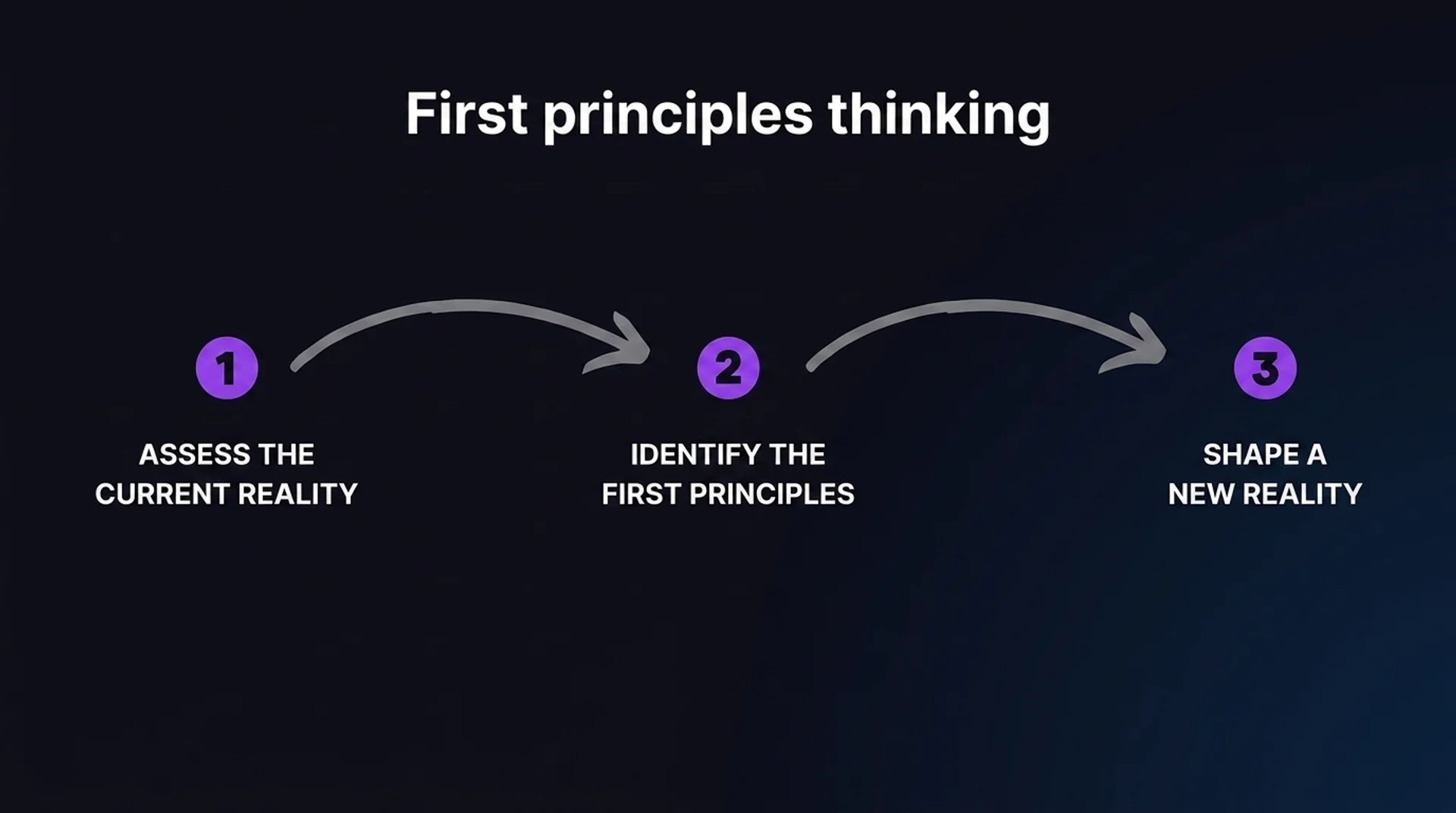
What is “First Principles Thinking”?
I’ve taken this from Chatgpt:
First principles thinking is a way of solving problems by breaking them down into their most fundamental truths and reasoning up from there, instead of relying on assumptions, analogies, or conventional wisdom.
Think of it as asking:
“What do I know is actually true?”
“If I started from scratch, what solution would I build?”
An example: Building a battery
Most people might think:
Batteries are expensive.
Therefore, making electric cars will always be expensive.
That’s reasoning by analogy—assuming the future will resemble the past.
A first-principles thinker would instead ask:
What is a battery made of?
Lithium
Nickel
Cobalt
Graphite
Manufacturing materials
What do those raw materials actually cost?
Is the high price due to the materials, the manufacturing process, or something else?
By questioning each assumption, you might discover that batteries could be made much more cheaply through better manufacturing or different chemistries.
This is the type of reasoning often associated with entrepreneurs like Elon Musk, though the concept dates back to the ancient Greek philosopher Aristotle.
I was forced to apply “First Principles Thinking” to survive
In 2014 I was in a dilemma.
A TMJ dentist had drilled my teeth and flattened them considerably sending my health into a tailspin.
Within about a month of that happening I had severe brain fog to the extent of having almost no short term memory. I felt like a hermit.
My neck and body were changing for the worse rapidly as if i was accelerated aging.
And a lot more.
It didn’t add up based on everything I’d understood about dentistry and how the body works.
And each time I went to a different dentist at that time it either made me feel worse or at best did nothing.
It was clear that there were some rules/logic that was not understood by the so called ‘experts’. And so I realized I would need to wipe the slate clean and learn them by myself.
Otherwise if I stayed in that condition I would be unable to take care of my family and live a normal life.
So after a few years of going in circles with dentists i said to myself “Screw it. I’m gonna assume these dentists are a bunch of idiots who learned all the wrong thing and i’m gonna figure out the rules to this game myself.”
Actually correction… i didn’t quite learn them by myself. I had a very talented partner in solving this problem, Marcello, who I have mentioned in the past several times.

How I applied First Principles Thinking
Similar to the example earlier in the article I started thinking about what I considered to be ‘existing truths’ back in 2014:
I was age 37 and my health had been pretty consistent to this point. I had made no major changes to diet or exercise
The only major change seems to have been this dentist who flattened the cusps on numerous teeth.
Therefore I can safely assume that somehow the flattening of dental cusps led to this massive set of health issues.
And then I started asking questions and challenging assumptions:
Question: Ok so why would flattening of cusps lead to such massive problems?
» Logical answer: Well logically it would either relate to the height of teeth playing an important role to how the skull works. Or how the teeth come together was disrupted by this because my bite had changed.
Assumption: Some TMJ dentists consider it fine to drill down your teeth in this way but reality is that they only understand teeth.
» Challenge to assumption: What if there are major negative consequences to this that they don’t understand? How would I test this hypothesis? Can I find others in FB groups who have a similar story?
And then I began running numerous tests in the ensuing years. For example I would:
test wearing a splint that locked my jaw forward. Locked my jaw back. Locked my jaw to the side.
test wearing a spint that was flat and did not lock the jaw at all.
test wearing a splint that allowed the jaw to move between two different positions: retrusion and protrusion
And for each test I needed to somehow figure out a way of measuring if i was progressing or regressing:
Relying on how I ‘felt’ could sometimes trick you i learned over time.
Using a tracking splint to measure changes to the curve of spee ended up being a reliable way of doing this. And over longer periods it seemed to align with how i felt (ie. improved curve of spee = I felt better).
More on that here:

So you see… by challenging assumptions and asking logical questions I eventually deduced a set of rules about how these ‘biomechanics’ worked. And those were:
You would improve if you added dental height and kept a flat occlusion. You would get worse if you took away height from your natural teeth (as that is the plane that was required by your skull),
If you locked a single position of the jaw you would get worse over time whereas if you locked both retrusion + protrusion on the same splint you could maintain and even improve slowly.

Why is this important to keep in mind?
This whole point about first principles thinking is important to keep in mind when talking to others.
Because people who have a similar mindset to me and do not just accept what the ‘experts’ say will have a far easier time accepting what I am saying as potentially true.
Not because I said it. But rather because they understand the logic by which i got there and so they have a pathway to re-test and see if my conclusions were correct.
This ability to logically follow along and make their own conclusions is more important than what is ‘widely accepted’.
Whereas a person who is a poor first principles thinker will generally go through life accepting what the ‘experts’ say. Often assuming those experts to have tons of evidence when in reality that evidence might be quite thin or perhaps flawed.
Or perhaps it only measures the impact in the first year but not what happens to the patient a decade down the road, which is a major problem for things like orthodontics where the collapsing impact draws on over years.
I also find so much of the health evidence I see out there to confuse causation and correlation.
And so a poor first principles thinker will often be nearly impossible to convince of this stuff unless they see ‘experts’ start to accept it. A single data point of a family member saying they are improving will often be insufficient.

Closing thoughts
My point today about first principles thinking is geared around two main goals:
for people that question whether this works I encourage them to follow a first principles process to conclude whether or not it does. And not just blindly assume it works because i say it does.
for people that see the positive benefits and want to convince loved ones you need to first understand the mindset of the person you are trying to convince. If they are not a first principles thinker you are likely gonna spin your wheels. They will probably need more time for this process to be more accepted out there.
I find that once you take this frame it removes a lot of frustration.
For example, in the old days I would go into a big shpeal trying to convince people of these biomechanics… explaining the logic and the various tests I did in the past.
But typically I realized later it had all fallen on deaf ears. Because the person was a poor first principles thinker.
So now i first probe to understand them better. Are they a confident first principles thinker or do they just accept what society tells them to do?
And if they are the type who needs to wait for the ‘experts’ to say it… then I save my energy. They will most likely not be an early adopter and that is fine.
You don’t win em all :)
I 200% agree. There is a reason why they coined the term “narrow minded” their skull is too narrow and mind too small to comprehend something and they would rather choose the easier path i.e do what others do, accept what’s widely accepted. Tell me that a person of such thinking made a difference? none. Because they’re biomechanically incapable. Its much easier to do what everybody does but doing the new is what changes everything. I believe in reviv because I can understand the theory and concept behind it. Our skulls are collapsing & we need to do something about it.
I like the idea of vetting the person. It will save lots of time talking to a brick wall! My feeling is, if they decide at some point that they're interested, THEN we can talk!