

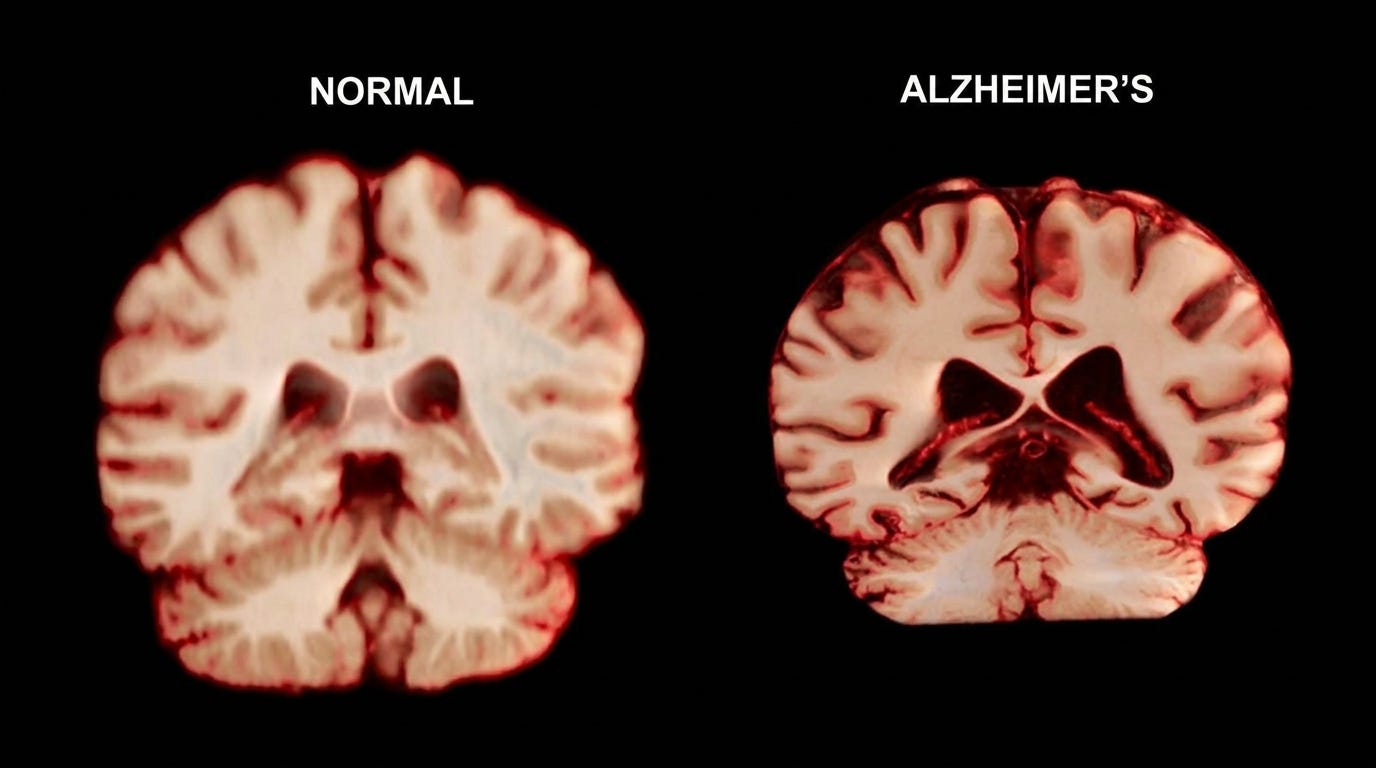
This guy in our community, Konstantinos, recently posted this really interesting image of a healthy brain vs. one with Alzheimer’s.
And it really blew me away.
As it was an angle I hadn’t thought of.
If the skull ‘deflates’ and compresses the brain as I talk about as part of my ‘balloon theory’… then it is only natural that the brain will literally get smaller.
And voila! It actually does! And the scientific community is even already aware of it!
Turns out that for decades, researchers have been uncovering a striking pattern: people with neurological diseases and mental health conditions consistently show reduced brain volume on imaging studies.
While the medical establishment typically attributes this to the diseases themselves, what if the relationship is actually reversed? What if having a smaller, compressed brain is actually the root cause of these conditions?
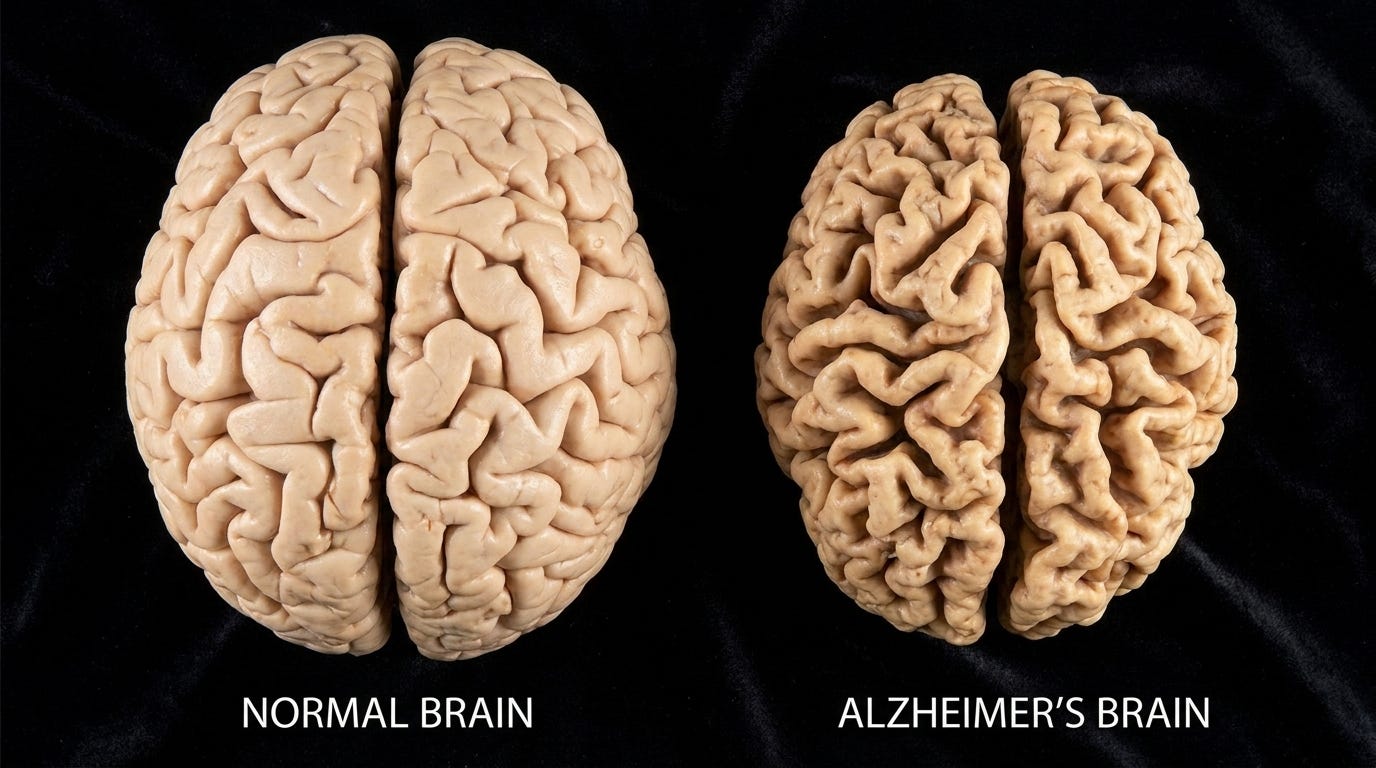
Neurologic disease patients have a smaller brain
The evidence for reduced brain volume in neurological diseases is overwhelming and consistent across multiple conditions. A comprehensive body of research has documented significant brain atrophy in patients with Parkinson's disease, Alzheimer's disease, multiple sclerosis, and various movement disorders.
Dr. Brendan Stack, a dentist I’ve written about before who has treated neurological diseases with dental appliances for decades, has observed this pattern repeatedly in his patients. His work, documented extensively on YouTube, shows how patients with severe movement disorders like dystonia and Parkinson's consistently present with structural issues in their skull and spine that would naturally compress brain tissue.

Studies using MRI technology have consistently shown that Parkinson's patients exhibit reduced volume in specific brain regions, particularly in areas controlling movement. Similarly, multiple sclerosis patients show characteristic brain lesions and overall volume reduction. Alzheimer's patients demonstrate progressive brain shrinkage that correlates with symptom severity.
What's particularly interesting is that these volume reductions often precede the onset of obvious symptoms by years or even decades. This suggests that the physical compression of brain tissue might be the triggering factor for the neurological dysfunction, rather than a consequence of it.
The pattern becomes even more interesting when you consider that you pretty much never see neurological disease patients who have perfect natural teeth with wide arches and wisdom teeth. This correlation points to a strong potential biomechanical relationship between dental structure and brain health.
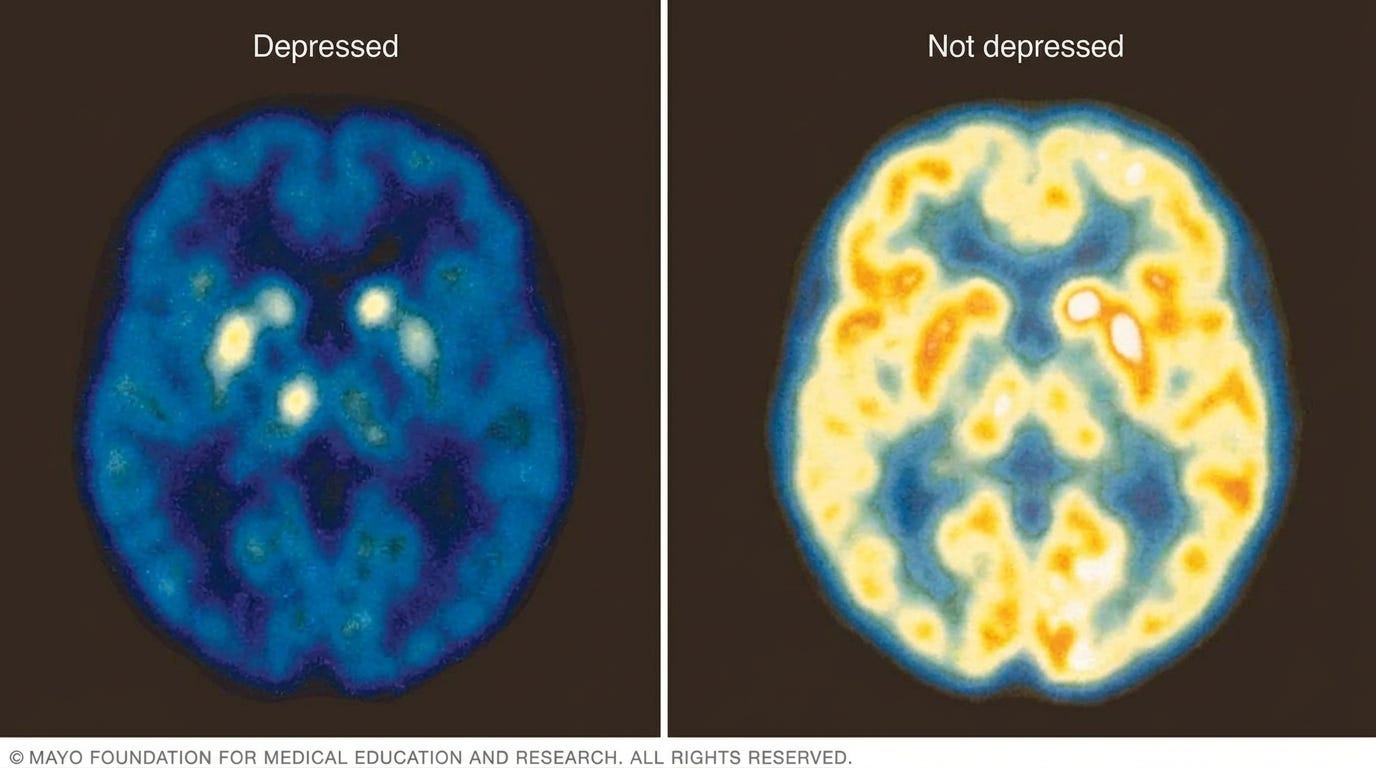
Mental health patients have a smaller brain
The connection between brain volume and mental health is equally well-documented in scientific literature. Patients with depression, anxiety, bipolar disorder, and schizophrenia consistently show reduced brain volume in key regions compared to healthy controls.
Research has repeatedly demonstrated that individuals with major depressive disorder show significant reductions in hippocampal volume - the brain region crucial for memory and emotional regulation. The longer someone has been depressed, the more pronounced this volume reduction becomes.
Anxiety disorders are associated with reduced volume in the prefrontal cortex and amygdala, areas critical for emotional processing and fear response. Bipolar patients show volume reductions in multiple brain regions, while schizophrenia patients often exhibit the most dramatic brain volume reductions of all psychiatric conditions.

What makes this even more compelling is the timing. Brain volume reductions in mental health patients often appear before the full manifestation of psychiatric symptoms, suggesting that the physical compression of brain tissue might be the root cause rather than a result of the mental illness.
My own experience strongly supports this connection. During periods of biomechanical collapse, mental health symptoms including depression, anxiety, and social withdrawal always reared their ugly head.
When the structural issues were corrected through these biomechanics, these mental health symptoms resolved completely without any psychiatric intervention.
The correlation between facial structure and mental health is also remarkably consistent. People with naturally wide dental arches and well-developed facial structure almost always exhibit good mental health and confidence, while those who have undergone orthodontics show much higher rates of mental health disorders and depression.

Can it really be this simple?
The idea that neurological diseases and mental health conditions could have such a straightforward physical root cause seems almost too simple to be true. Yet when examined logically, it makes far more sense than current explanations.
Consider the prevailing theories for these conditions: genetics, neurotransmitter imbalances, environmental factors, and lifestyle choices. While these may play contributory roles, they fail to explain the consistent patterns we observe.
If these conditions were primarily genetic, we would expect to see consistent rates across generations. Instead, neurological diseases and mental health issues have skyrocketed in recent decades, suggesting environmental or mechanical factors are at play.
The biomechanical explanation provides a unifying theory. When dental height is lost through grinding, orthodontics, or extraction, it triggers a cascade effect where the soft tissue surrounding the skull "deflates," crushing the skull inward and compressing the brain.
This compression disrupts normal neurological function and can manifest as either neurological disease or mental health symptoms, depending on which brain regions are most affected.

This theory explains why you pretty much never see someone with perfect natural teeth, wide arches, and excellent spinal structure who suffers from severe neurological disease or mental health issues. It also explains why these conditions often worsen progressively over time - as the biomechanical collapse continues, brain compression increases.
The evidence contrary to this theory primarily comes from the medical establishment's focus on biochemical rather than biomechanical factors. Researchers point to neurotransmitter imbalances, genetic markers, and cellular pathology as evidence that these are primarily medical rather than mechanical conditions.
However, these biochemical changes could easily be downstream effects of mechanical brain compression rather than root causes. When brain tissue is physically compressed, it's entirely logical that cellular function, neurotransmitter production, and genetic expression would be disrupted.
The pharmaceutical approach of treating symptoms with drugs, while sometimes providing temporary relief, has never been shown to reverse the underlying brain volume loss. In contrast, case studies of folks like my old friend, Marcello, who reversed severe cervical dystonia through these biomechanics, demonstrate that addressing the mechanical root cause can lead to complete recovery.
Closing thoughts
The relationship between brain size and neurological health may be one of the most important overlooked connections in modern medicine.
In my view the evidence is almost too solid to not have a direct cause & effect relationship.
The problem before was that researchers and doctors didn’t have anything that was actionable. “Ok so the brains of people with neurological and mental health conditions are smaller… so what does that mean?”
They didn’t know.
But we are filling in this important blank.
They are smaller because the skull collapsed in on the brain due to biomechanics that relate to the teeth.
And a simple mouthguard essentially reverses the process and ‘re-inflates’ the skull. Thereby basically potentially correcting all of these conditions.
I have almost no doubt that this is going to turn out to be mostly true. Just watch ;)

I was diagnosed with dystonia & placed on Sinemet, which is used in Parkinson’s.
I have improved my symptoms with physical modalities, NUCCA chiropractic care, eye muscle dysfunction correction & my Reviv is now another piece now within my healing healing—I had identified imbalance between all these systems—all related to body feeling grounded in space. It takes up do much cognitive bandwith to ground when the body is getting wrong proprioceptive input.
High hopes w Reviv.
I am a 65+ whose cognitive abilities have IMPROVED.
I used to not be able to remember an OTP code from text to browser. I now can do 6 digits!
I do not have severe “shut down” muscle pain as I undo all my physical compensation.
I have been trying the reviv mouth gaurd for a short time and already noticed some changes in my sinuses, I think your work is really important.
Wrt “is it really that simple” when you look at the images of the Alzheimer’s brain the space between the folds has gaps in it. The skull collapse is a really interesting hypothesis and seems to be at play given the overall size but given the recent surgical interventions in the neck which have increased lymph drainage from the interstitia of the brain and skull I would speculate that fluid pressure due to soft tissue restrictions in the neck are also at play.